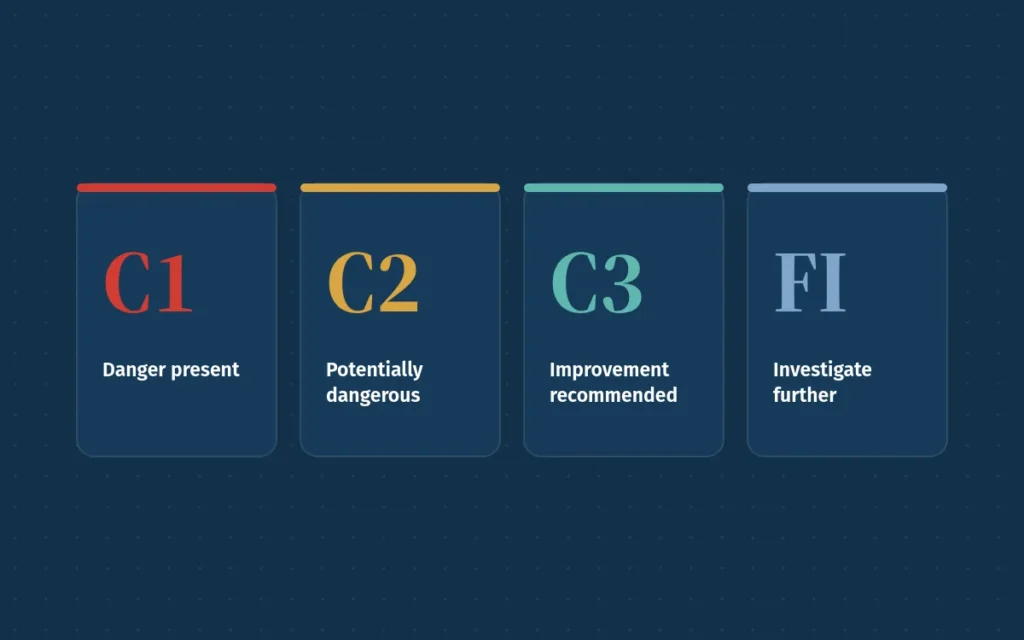
Every observation in an EICR gets a code. Any C1, C2 or FI makes the report unsatisfactory; a C3 on its own doesn’t. Here is what each one means for you as a landlord.
The short answer
C1 means danger now, C2 means potentially dangerous, FI means something needs investigating, and C3 means an improvement is recommended. A report with any C1, C2 or FI is unsatisfactory, and you have 28 days (or less, if the report says so) to get the work or investigation done. C3 items alone leave the report satisfactory.
| Code | What it means | Report result | What you do |
|---|---|---|---|
| C1 | Danger present: a risk of injury right now | Unsatisfactory | Make safe straight away |
| C2 | Potentially dangerous | Unsatisfactory | Fix within 28 days, or sooner if the report says so |
| FI | Further investigation needed | Unsatisfactory | Investigate within 28 days, or sooner if the report says so |
| C3 | Improvement recommended | Doesn’t fail on its own | No legal deadline; worth planning for |
C1: danger present
There is a risk of injury right now, such as live parts you can touch. The inspector should make it safe or tell you immediately. The report is unsatisfactory, and the work can’t wait for the 28 days.
The government’s guidance notes that the inspector may make a C1 hazard safe before leaving the property. The repair itself still has to follow.
C2: potentially dangerous
Not dangerous this minute, but it could become so, such as missing main bonding or signs of overheating. The report is unsatisfactory: fix it within 28 days, or sooner if the report says so.
C3: improvement recommended
The installation doesn’t meet the current edition of BS 7671 but isn’t unsafe. A C3 on its own doesn’t make the report unsatisfactory, and there’s no legal deadline to act on it. It’s still worth planning for.
FI: further investigation
Something the inspector couldn’t confirm during the visit, such as a circuit that can’t be traced or a test reading that needs explaining. The report is unsatisfactory until it has been investigated, within 28 days.
An FI is not a verdict that something is wrong; it means the answer isn’t known yet. If the investigation finds that work is needed, the same steps apply again to that work: done within the time allowed, then confirmed in writing.
What “unsatisfactory” means
It’s the overall result the inspector gives the whole installation. One C1, C2 or FI is enough for it. A report with any number of C3 items and nothing else is still satisfactory. An unsatisfactory report is not a fine or a failure on your part; it’s the start of the 28 days you have to put things right.
Common findings, and how they’re usually coded
- Exposed live parts, such as a broken socket face or missing blanks in the fuse board: typically C1.
- No main bonding to the gas or water pipes: typically C2.
- Scorching or signs of overheating at a socket or the fuse board: typically C2.
- No RCD on a socket likely to power equipment outdoors: typically C2.
- No RCD on general indoor sockets in an older installation: typically C3.
- Missing circuit labels or warning notices: typically C3.
- Old red and black cable colours in good condition: usually no code on its own.
The inspector decides the code on site, so treat these as typical outcomes, not guarantees.
Is a plastic consumer unit an automatic fail?
No. Current rules want new consumer units in homes to have non-combustible enclosures, but an older plastic board in good condition isn’t a failure on its own. The inspector may recommend an upgrade, usually as a C3, depending on its condition and where it is.
After an unsatisfactory report
Any C1, C2 or FI item has to be fixed or investigated within 28 days, or sooner if the report says so. You then confirm the work in writing to the tenant and the council within 28 days of finishing. We give you an itemised quote, and you’re free to use any qualified electrician.
- Deal with any C1 at once. If the inspector made it safe, book the repair; if not, ask a qualified electrician to make it safe straight away.
- Get the remedial work and any investigation done within 28 days of the inspection, or the shorter time the report gives.
- Ask for written confirmation from the qualified person who did the work. The guidance accepts a satisfactory EICR, an Electrical Installation Certificate, a Minor Electrical Installation Works Certificate or other suitable electrical certification.
- Send the report and that confirmation to your tenant and to the council within 28 days of the work being finished.
- Keep copies of the report and the certificates together, ready for the council and for the next inspector.
The legal position
The deadlines come from the Electrical Safety Standards in the Private Rented Sector (England) Regulations 2020, regulation 3(4) to 3(6). If a council believes a landlord is in breach, it can serve a remedial notice, arrange urgent work itself and recover the cost, and impose a civil penalty of up to £40,000 per breach.
Questions landlords ask about codes
Do I have to fix C3 items?
No. The guidance is clear that a C3 doesn’t call for remedial work; it only recommends an improvement. As the guidance also says, acting on it would still improve the safety of the installation.
Can a different electrician do the remedial work?
Yes. Any qualified person can carry out the work. What matters is that they give you written confirmation, such as a certificate, that you can send to the tenant and the council.
Is the 28 days counted from the inspection or from the report?
The regulations count it from the inspection, unless the report sets a shorter time. That’s why a quick report matters: ours reaches you within 48 hours of the visit, so most of the 28 days is left for the work.
Related guides
- What an EICR actually checks in a rented home
- Ready for the inspector? Eight jobs before an EICR
- The landlord electrical safety rules, in plain English
Got a report you’d like explained? Call 020 3386 1854 or send us a message.

